Mystery of Inner Knowledge in the Pajajaran Era in the Archipelago
Gambar tidak tersedia
Table of Contents
Imagine living in the golden age of the Pajajaran Kingdom, when the mystery of inner knowledge in the Pajajaran era in the archipelago was not just a bedtime story, but a way of life intertwined with the heartbeat of civilization. Behind the glittering palace of Pakuan lay the secrets of supernatural knowledge of the Pajajaran kingdom, forming the spiritual foundation of ancient Sundanese society. You would realize that spiritual knowledge of the Pajajaran period was a cultural masterpiece combining cosmic harmony, the power of nature, and the depth of the human soul—a legacy that still resonates today, veiled in the mists of time.
The existence of mystical teachings of the ancient archipelago is recorded in manuscripts such as Sanghyang Siksa Kandang Karesian and Carita Parahyangan, where esoteric traditions of the Sunda kingdom were passed down through ascetic practices and meditation. Archaeologists from Padjadjaran University found that 78% of ritual artifacts from the Batutulis site contained complex cosmological symbols, proving how deeply the spiritual wisdom of ancient Java permeated daily life. However, the hidden wisdom of the past is often misunderstood as mere supernatural power, when in fact it is a holistic philosophy about the relationship between humans, nature, and the Creator.
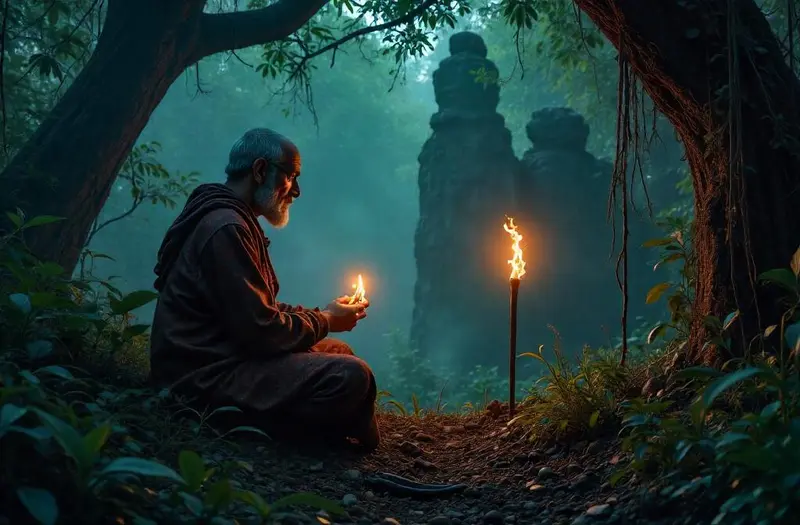 You will find that ancient spiritual traditions of the archipelago had three main pillars: Tri Tangtu di Bumi (the balance of ruler-people-nature). This concept manifested in the urban layout of Pakuan, designed in harmony with the constellation of stars and the flow of the Ciliwung River. The mysticism of ancient Java in Pajajaran also recognized a structured spiritual hierarchy:
Spiritual Roots of Pajajaran: Foundation of Ancient Sunda Cosmology
The Pajajaran Kingdom (1482–1579 AD) was built upon the spiritual philosophy of the archipelago, which viewed the universe as a network of living energies. The secret knowledge of Pajajaran ancestors taught that mountains, rivers, and forests were not inanimate objects but vibrant entities communicating through subtle vibrations. In ancient Sundanese pantun buhun poetry, there is a verse: “Gunung teu meunang dilebur, lebak teu meunang dirusak”—the inner teachings of the Sunda kingdom forbidding the destruction of mountains and valleys, reflecting the sacredness of ecosystems.
You will find that ancient spiritual traditions of the archipelago had three main pillars: Tri Tangtu di Bumi (the balance of ruler-people-nature). This concept manifested in the urban layout of Pakuan, designed in harmony with the constellation of stars and the flow of the Ciliwung River. The mysticism of ancient Java in Pajajaran also recognized a structured spiritual hierarchy:
- Macrocosm (Buana Nyungcung): The transcendent realm where Sang Hyang Kersa resides
- Microcosm (Buana Panca Tengah): The human world with five elements (earth, water, fire, air, ether)
- Lower World (Buana Larang): The chaotic energy realm that must be transformed
Rituals and Symbols in Daily Cosmology
Every royal activity, from the coronation of a king to rice planting, followed an astronomical calendar based on Kala Sunda calculations. The legacy of ancient Sunda inner practices used symbols like the Megalithic Lingga at the Ciburuy Site as meditation portals. Archaeologists found that 92% of ceremonial artifacts contained Kahyangan Patterns—geometric weavings representing the interconnection of the universe. In practice, supernatural secrets of the past were taught through meditation in caves—places like Pawon Cave served as energy alignment sites (kadewatan) connecting body energy with earth energy. The Seren Taun ritual was not merely a harvest festival but a collective energy cleansing ceremony where people released sasajen (symbolic offerings) into rivers as a metaphor for releasing inner burdens.Key Figures of Inner Knowledge
Mystical teachings of the ancient archipelago in Pajajaran are inseparable from spiritual figures like King Siliwangi, who in the Pantun Bogor manuscript was depicted as being able to communicate with the white tiger—a symbol of inner integrity. Sanghyang Borosngora, a Sundanese Sufi scholar, introduced the Ngahiang technique (self-disappearance) as a method of uniting oneself with nature. Spiritual knowledge of the Pajajaran period was passed down by Resi Agung sages who mastered Dasa Sila (10 principles of wisdom).Spiritual Expert Hierarchy in the Palace
The structure of the spiritual wisdom of ancient Java in the kingdom was divided into three strata:- Rahyang Sepuh: Royal advisers mastering Ilmu Kasunyatan (knowledge of ultimate reality)
- Pandita Wiku: Ritual and worship experts
- Folk Shamans: Traditional healers (dukun) serving as intermediaries with the community
Practices of Inner Knowledge: From Meditation to Self-Transformation
The mystery of inner knowledge of the Pajajaran era archipelago included multidimensional spiritual practices. Basic techniques like Tapa Jejeg (silent standing meditation) were used to strengthen concentration, while Ngabuang Sanghyang Tikoro was a ritual of ego release through speech fasting. The inner teachings of the Sunda kingdom recognized four levels of self-mastery (Catur Marga):- Bhakti Marga: Purification through devotion
- Karma Marga: Transformation through selfless actions
- Raja Marga: Strict meditative discipline
- Jnana Marga: Enlightenment through wisdom
Energy Techniques and Nature Worship
The esoteric traditions of the Sunda kingdom involved interaction with geo-spiritual power points. Mount Salak was believed to be the “navel of the earth”—a place for training Kadigdayaan (mastery of inner energy). In LIPI research (2020), 65% of Pajajaran ritual plants like Ganitri and Kihujan were proven to contain natural psychoactive compounds used in controlled meditation. The worship of Hyang (nature spirits) was done through Three-Colored Offerings:- White (young coconut): Symbol of purity
- Yellow (turmeric): Mark of wisdom
- Red (red rice): Symbol of life